


By Mosisa Aga

Who Is Farah Maalim, and Why Do His Words Matter?
Farah Maalim is a Kenyan Somali politician and a Member of the National Assembly representing Dadaab Constituency in Garissa County. Born in Garissa, he has had a long career in Kenyan politics, including serving as Deputy Speaker of the National Assembly from 2008 to 2013. He is also known for his involvement in political issues affecting Somali communities in the Horn of Africa, particularly the Ogaden question.
His involvement in the Ogaden issue is not merely incidental. In Talking Peace in the Ogaden: The Search for an End to Conflict in the Somali Regional State in Ethiopia, researcher Tobias Hagmann describes Maalim as a Kenyan Somali politician regarded by some Somalis as sympathetic to the Ogaden National Liberation Front (ONLF) struggle. The study also documents his participation in efforts by Kenyan officials to facilitate negotiations between the Ethiopian government and the ONLF in 2012. This background is relevant because it demonstrates that Maalim has long been involved in political discussions concerning the rights, grievances, and aspirations of Somali communities beyond Kenya.
Maalim’s political interventions outside Kenya have also attracted controversy. In January 2023, Somaliland President Muse Bihi Abdi accused him of encouraging resistance and contributing to ethnic tensions in Las Anod, allegations Maalim rejected, saying that he had spoken out against human rights violations against civilians. In July 2024, Kenya’s National Cohesion and Integration Commission asked Maalim to appear before it after a video circulated in which he reportedly threatened to use extreme violence against anti-government protesters. He claimed that the video had been edited. In January 2025, Wiper Democratic Movement leader Kalonzo Musyoka announced Maalim’s expulsion from the party over further controversial public remarks. Maalim disputed the significance of the decision, saying he had already resigned from his deputy party leadership position months earlier. These incidents provide important context for understanding the controversy surrounding his public interventions in politically sensitive disputes.
Maalim’s position as a Kenyan Member of Parliament makes his public statements especially consequential. He is not simply an ordinary citizen expressing a personal opinion. He is an elected representative whose words carry political weight and can influence public attitudes, particularly during periods of heightened ethnic tension. With that public position comes a responsibility to exercise restraint, distinguish verified facts from allegations, and avoid language that could deepen hostility between communities.
This responsibility has become particularly important following the recent outbreak of violence in Moyale. Soon after the conflict began, Maalim publicly expressed support for the Somali side. In subsequent interviews, he made a series of sweeping allegations about Oromo political dominance, alleged Oromo territorial expansion, and the supposed intention of Oromo leaders to take Somali territories. He also made categorical claims about Moyale, declaring that it belongs to the Somali Region rather than Oromia. In another interview, without providing census data, he claimed that only 14 percent of Moyale’s residents are Oromo and that Somalis constitute the majority according to “the last census”.
These statements came amid a conflict that resulted in deaths and the displacement of tens of thousands of people. The violence also had consequences beyond Ethiopia. In Borama, Somaliland, Oromo residents reported that more than 150 homes belonging to Oromos had been damaged or looted following the clashes in Moyale. These developments reveal how quickly ethnic hostility can spread across borders and endanger communities far removed from the original conflict. Maalim’s public statements, particularly his unequivocal support for one side and his repeated portrayal of Oromos as an expansionist threat to Somalis, must be examined in this context. As an elected Kenyan parliamentarian, he cannot disregard the potential consequences of such rhetoric, especially when tensions are already high. Political leaders have a responsibility to promote restraint and peaceful coexistence, not to deepen divisions through sweeping and unsubstantiated accusations.
Moyale: History, Identity, and the Unresolved Territorial Question
The current conflict in Moyale is primarily presented by less informed individuals between two neighboring communities, the Borana and the Garri, whose histories in the area go back generations. The two communities have lived alongside one another, maintaining longstanding social, economic, and cultural relationships, even as disputes over land, grazing areas, water resources, and local authority have sometimes strained their relations. Moyale and its surrounding areas are part of the historical homeland of the Borana Oromo, whose cultural, linguistic, economic, and customary connections extend across the present-day Kenya-Ethiopia border. The Garri, too, have longstanding historical, linguistic, and cultural connections with the Oromo. Oromos regard the Garri as part of the broader Oromo people, and Afaan Oromo is spoken among Garri communities. Although political identities and affiliations have evolved over time, these developments should not erase the Garri’s historical connections with the Oromo or deny the Borana Oromo’s longstanding rights in the area. These complex relationships are explained in Marco Bassi’s scholarly study and a more recent study of Halake Jaldessa Liban and Asafa Jalata in the Journal of Oromo Studies.
Moyale’s present administrative division emerged from political decisions made following the overthrow of the Derg regime in 1991 by the TPLF-led EPRDF government. This Tigrayan-led government sided with the Garri to use them against the Oromo Liberation Front (OLF) that was functioning in the Borana community. Under the new arrangement, 11 kebeles in Moyale district were assigned to the Somali Region, including important Borana wells and grazing areas, while 17 others, including Moyale town, were assigned to Oromia. These arrangements did not settle competing claims. The Garri established a separate administration in several kebeles, and following the creation of the Somali Regional State in 1995, which established its own Moyale district and administrative offices in the town. This gradually produced two parallel administrations, each with its own officials, police, and other institutions. The main road eventually became the de facto dividing line between them. Thus, the division was not simply the result of an ancient, clearly established clan boundary, but of political decisions that institutionalized competing territorial claims.
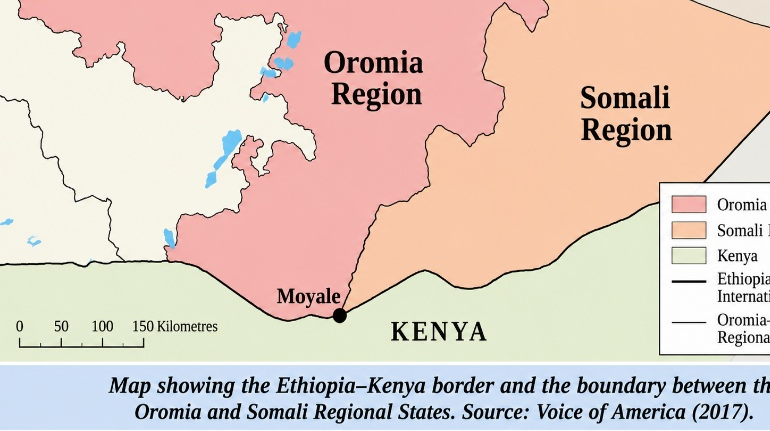
These developments must be further understood in the context of the TPLF-led government’s war against the OLF. The Borana, including communities in Kenya, were widely known for their sympathy and support for the OLF, while the Garri were generally less sympathetic to the organization and had longstanding disputes with the Borana. A portion of the Garri population also increasingly identified politically with the Somali Regional State and the broader Somali political identity. In his scholarly study, Marco Bassi examines the political and administrative developments in the Borana area, including the government’s security concerns over the OLF insurgency. This provides an important historical context for understanding the government’s policies toward the Borana and the wider border dispute.
The Borana communities have long maintained that the TPLF government, using the Oromo People’s Democratic Organization (OPDO) as its regional instrument, exploited existing divisions between the two communities to weaken Borana support for the OLF. A recurring Borana complaint is that government forces armed Garri groups and sometimes fought alongside them during clashes, drawing OLF fighters into local disputes and turning them into wider confrontations with government forces. Borana communities came to view these interventions over the 27 years of TPLF-led rule as a deliberate strategy that aggravated existing disputes and deepened hostility between the two communities.
The 2004 referendum provides important evidence about the wider Oromia-Somali boundary dispute. According to the official report of Ethiopia’s National Electoral Board, 64.8 percent of votes cast in the participating disputed kebeles favored administration by Oromia, compared with 35.2 percent for the Somali Regional State. However, the referendum was not completed in Moyale. The Electoral Board identified nine Moyale kebeles where the process had been delayed, and academic studies independently confirm that Moyale was excluded from the completed referendum. Marco Bassi documents the postponement of voting in all nine kebeles, while Fekadu Adugna specifically reports that the referendum failed to take place in four kebeles in Moyale town and its surrounding area. Boku Tache and Gufu Oba likewise conclude that the Moyale case remained unresolved. Hence, Moyale’s administrative status remained unresolved, while the competing regional administrations continued to operate in the town.
Maalim’s additional claims that only 14 percent of Moyale residents are Oromo, and that Somalis are the majority according to the last census, also requires scrutiny. He does not identify the census, its date, the geographical boundaries used, or the population categories on which his figure is based. More importantly, even an accurate population count would not establish exclusive territorial ownership. Population figures may inform discussions about representation and administration, but they cannot erase the historical presence, customary connections, and rights of communities that have lived in an area for generations.
The conflict between the Borana and Garri communities must be understood within this broader historical and political context. Disagreements over grazing land, water resources, settlement, and local authority should not be turned into a territorial confrontation between the two sub-groups of the Oormo nation with longstanding historical and social ties. Nor should the political alignment of a portion of the Garri population with Somali institutions be treated as proof that the entire area belongs exclusively to the Somali Region. Nevertheless, some Somali expansionist voices, both in the Horn of Africa and beyond, have asserted that Moyale belongs to Somalis and have extended their territorial claims to parts of Eastern and Southern Oromia. Maalim’s declaration that “Moyale is not part of the Oromia region; Moyale is part of the Somali region” similarly presents a contested administrative arrangement as though it were an established historical fact. Such declarations cannot erase the Borana Oromo’s longstanding historical presence or invalidate their legitimate interests in the area.
Moyale’s future must be addressed through a process that respects the historical rights of the Borana Oromo, the rights of the Garri and other communities living there, and the interests of the people who call the area home. It should not be determined by expansionist slogans or exclusive territorial claims made by politicians from outside the area.
Allegations of Oromo Expansionism and Domination
In his live interview, Farah Maalim advances an alarming narrative of Oromo expansionism. He alleges that Ethiopia’s Prime Minister, the President of Oromia, and the Chief of the Armed Forces share a coordinated agenda to seize Somali territories, describes Somali border areas as a “soft target,” and claims that millions of settlers have been implanted in the Somali Region to make Somalis a minority. He further links these allegations to Ethiopia’s pursuit of sea access and portrays the country as having passed from Amhara and Tigrayan domination to Oromo domination. Yet he provides no credible evidence of an official policy of territorial expansion, a coordinated settlement program, or a government plan to dispossess Somalis. The Oromo identity of senior officials, by itself, does not establish a common political agenda or prove that they represent the interests of the Oromo people. In fact, these officials work together with the Ogaden Somlia Regional State while terrorizing and displacing Oromos in Eastern and Southern Oromia to suppress Oromo nationalism and crush the Oromo Liberation Army, which is active in these areas.
The political history is more complicated than Maalim suggests. The OPDO was renamed the Oromo Democratic Party (ODP) in 2018, and the ODP subsequently merged with other EPRDF member parties to form the Prosperity Party in December 2019. This organizational continuity does not mean that the present government represents Oromo aspirations. Oromo communities have continued to experience repression, displacement, and killings under the current administration. Nor should the presence of Oromo officials in Ethiopian senior government positions be confused with the protection of Oromo national interests or territorial rights.
Indeed, the historical record demonstrates that Oromo communities have suffered serious abuses under successive Ethiopian governments. During the TPLF-led EPRDF period, Human Rights Watch documented frequent attacks by individuals believed to belong to the Somali Region’s Liyu Police against communities in Oromia in 2017. These attacks involved killings, assaults, looting, and displacement. HRW also criticized the federal government for failing to stop the incursions. Under the current government, the UN Office of the High Commissioner for Human Rights reported 366 people killed in Oromia in 2023, amid fighting involving government forces and the OLA, as well as intercommunal violence. The report also documented serious abuses by government forces. These findings make it difficult to portray the presence of Oromo officials in government as evidence that Oromo communities are protected or politically empowered.
The violence in western Oromia also exposes the weaknesses in Maalim’s one-sided account. The International Commission of Human Rights Experts on Ethiopia documented attacks against both Amhara and Oromo communities in Wollega and other parts of Oromia. The Commission received witness accounts of killings and other abuses against Oromo communities attributed to Fano militias. It also expressed concern that government or regional security forces had withdrawn from some areas shortly before the attacks, leaving Oromo communities unprotected. Oromos have experienced abuses under both the TPLF-led EPRDF government and the present administration. Their history of repression, displacement, and violence cannot be dismissed simply because individuals of Oromo origin hold political office. Territorial rights, civilian protection, and accountability must apply equally to Oromos, Somalis, Amharas, and all other communities.
Ethnic Exceptionalism, Resistance, and Self-Determination
Maalim’s interview mentioned above includes repeated assertions about Somali bravery and military strength. He says that nobody can take Somali land because those who try will be defeated. He invokes the United States and Iran, compares Somalis with the Houthis in Yemen, and declares that “Somalis are as good, if not better.” He further describes Somalis as a people who know how to fight and die and who will never accept subjugation because it is in their “genes” and “DNA.” These racist attitudes are intended to encourage Somalis to go war with Oromos.
Somalis, like Oromos and many other peoples, have histories of resistance and sacrifice. But there is a difference between affirming a community’s courage and portraying its capacity for violence as an inherited ethnic characteristic. Courage is not the exclusive property of any ethnic group, nor is a willingness to fight or die a biological characteristic. Such language reinforces racism and stereotypes and risks presenting conflict between communities as inevitable. Political disputes over land and self-determination should be addressed through justice and equal rights, not competition over which ethnic group is more capable of fighting.
Maalim also says that Somalis will resolve their internal problems and fight for independence because they have lived under a form of colonial subjugation. This raises an important question of political consistency: does he recognize the same principle of self-determination when it is invoked by Oromos? The Oromo people have their own history of political grievances and struggles for self-determination, representation, land, language, and cultural rights. One does not have to agree with every Oromo political demand to recognize that these issues deserve serious consideration. Maalim’s earlier political engagement makes this question particularly relevant. Hagmann’s study describes him as a Kenyan Somali politician regarded by some Somalis as sympathetic to the ONLF struggle and documents his involvement in efforts to facilitate negotiations between the Ethiopian government and the ONLF.
Supporting Somali self-determination and criticizing the Ethiopian state are not incompatible with recognizing the rights of Oromos and other peoples. If self-determination is a legitimate aspiration for Somalis, it cannot automatically become illegitimate when Oromos invoke it. What is difficult to defend is a political standard that recognizes the aspirations of one community while portraying those of another as inherently expansionist or threatening. The same principles of political recognition, justice, and self-determination must apply equally to both.
Political Responsibility and the Need for Accountability
The recent events in Moyale demonstrate how quickly a localized dispute can develop into a wider humanitarian crisis. Reports of deaths, mass displacement, and attacks on civilians are deeply troubling. Particularly alarming are reports that more than 150 homes belonging to Ethiopian residents, many of them Oromo, were damaged, looted, or burned in Borama, Somaliland. Somaliland authorities have condemned the attacks, announced arrests, and promised investigations. People who have taken refuge in another community should not be punished for a conflict taking place elsewhere. Their homes and livelihoods should not become targets because of their national/ethnonational identity.
Most Oromos, myself included, are deeply concerned that inflammatory political rhetoric surrounding the Moyale conflict has contributed to hostility directed at Oromo communities beyond Ethiopia. Maalim’s statements, which portray Oromos collectively as expansionists seeking to seize Somali territory, are part of this troubling atmosphere. I cannot establish that his remarks caused the attacks in Borama. Nevertheless, the timing and nature of these developments make it necessary to examine the role of influential public figures in either encouraging or discouraging ethnic hostility.
This concern is not mine alone. Marsabit Governor Mohamud Ali publicly criticized Maalim and other Kenyan leaders for their statements about the conflict, warning that political leaders should avoid taking sides and instead promote peaceful coexistence. The governor also recalled that he and Maalim had previously worked together in 2020 to raise concerns about the persecution of Oromo communities by the then Tigray administration. His criticism underscores the responsibility of political leaders to exercise restraint, especially when their words may affect communities across national borders.
Maalim is entitled to express his views and advocate for the rights of Somali communities. However, as a sitting Kenyan Member of Parliament representing Dadaab, he also has a responsibility to avoid interventions that could intensify hostility in neighboring communities. His public statements should be examined in light of their content, timing, and potential consequences. I therefore call on the Kenyan government and the relevant parliamentary authorities to examine his public interventions and determine whether they are consistent with the responsibilities and standards expected of an elected representative. Political influence should be exercised in the service of peace and the protection of civilians, not in ways that deepen ethnic divisions beyond one’s country’s borders.
The people of Moyale and the surrounding areas need peace, security, and a fair resolution of their political and administrative disputes. Somali residents have rights that must be protected. Borana Oromo residents have rights that must also be protected, too. The same principle applies to every community in the area. No one should be displaced, intimidated, or denied rights because of their identity.
Ultimately, the question is not which community is more powerful, more courageous, or more capable of fighting. It is whether the principles of justice, democracy, equality, historical recognition, and political self-determination can be applied consistently to all communities.
Whose history? Whose territory? And whose interests are served by deepening these divisions? These questions cannot be answered through declarations, threats, or ethnic generalizations. They require historical evidence, political honesty, mutual respect, and a genuine commitment to the equal rights and dignity of all peoples.
Note: Mosisa Aga is a professor of mathematical statistics at Alabama University Montgomery, USA and a former president of the Oromo Studies Association (OSA) and may be reached at mosisaaga@gmail.com


